Your Employees Are Still Your Biggest Cybersecurity Risk | ResolveIT
The strongest cybersecurity strategy doesn't begin with technology—it begins with people.
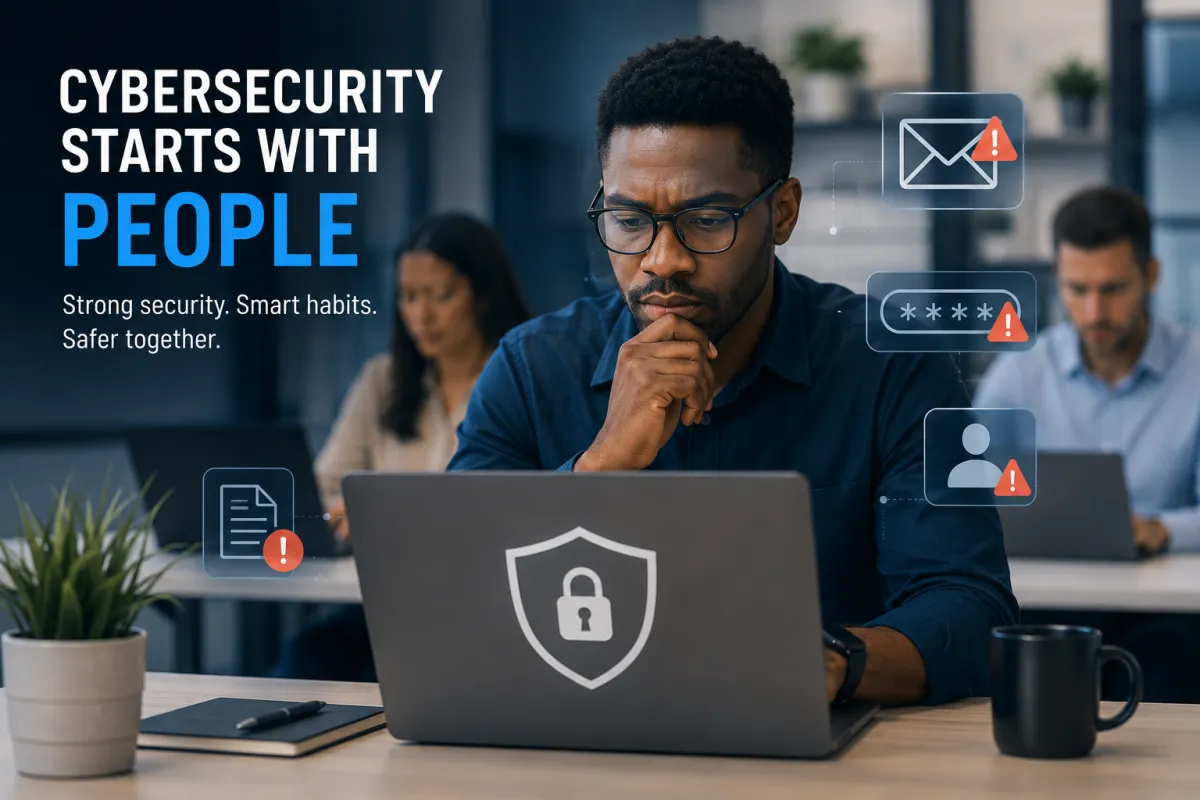
Cybersecurity Starts with People
When most business leaders think about cybersecurity, they picture sophisticated hackers, ransomware attacks, or complex malware designed to bypass advanced security systems.
While these threats are real, one of the greatest risks facing organizations today is far less technical.
It's human behaviour.
Every day, employees make hundreds of decisions involving email, passwords, customer information, file sharing, mobile devices, and cloud applications. Most of these decisions are routine. Some, however, can unintentionally create opportunities for cybercriminals.
Cybersecurity is no longer just about protecting systems. It's about helping people make safer decisions.
Here are five reasons why employees continue to represent one of the biggest cybersecurity risks—and what organizations can do about it.
1. Cybercriminals Target People Before Technology
Modern cyberattacks rarely begin by attacking firewalls.
They begin by attacking trust.
Phishing emails, fake invoices, fraudulent payment requests, and impersonation scams are all designed to persuade someone to click a link, open an attachment, or reveal sensitive information.
Cybercriminals understand that convincing one employee is often easier than breaking through sophisticated security technology.
Organizations that invest in employee awareness alongside technical controls significantly reduce their exposure to these attacks.
2. Password Habits Continue to Create Risk
Weak passwords, reused passwords, and shared credentials remain common across organizations of every size.
When employees reuse passwords across multiple platforms, a single compromised account can potentially expose several business systems.
Modern organizations reduce this risk by implementing:
Multi-Factor Authentication (MFA)
Password managers
Single Sign-On (SSO)
Strong password policies
Security should be easy enough that employees naturally follow it.
3. Shadow IT Is Growing Faster Than Most Businesses Realize
Employees often download applications or subscribe to online services simply to make their jobs easier.
While these decisions are usually well intentioned, they create technology environments that IT teams cannot properly secure, monitor, or support.
Known as "Shadow IT," these unmanaged applications can introduce security vulnerabilities, duplicate sensitive information, and increase compliance risks.
Organizations should encourage innovation while maintaining visibility and governance over the technology employees use.
4. Hybrid Work Has Expanded the Attack Surface
Today's workforce no longer operates exclusively within the office.
Employees work from home, airports, hotels, client sites, and public spaces using laptops, smartphones, tablets, and cloud applications.
While hybrid work has increased flexibility and productivity, it has also expanded the number of potential entry points available to attackers.
Protecting today's workforce requires more than securing office networks.
It requires protecting identities, devices, cloud applications, and remote access wherever employees work.
5. Cybersecurity Is a Culture—Not Just a Technology Stack
Organizations with the strongest security posture don't necessarily own the most expensive technology.
Instead, they build a culture where cybersecurity becomes everyone's responsibility.
Employees understand how to identify suspicious activity.
Leaders actively discuss cyber risk.
Security awareness becomes part of onboarding.
Incident reporting is encouraged.
Policies are reviewed regularly.
Technology supports people—but people ultimately determine how effectively that technology is used.
Cybersecurity succeeds when it becomes part of organizational culture rather than simply another IT initiative.
The Bottom Line
Technology continues to evolve rapidly, but human behaviour remains one of the most significant factors influencing cybersecurity outcomes.
Organizations that invest only in technology while neglecting employee awareness leave themselves vulnerable to attacks that technical controls alone cannot prevent.
By combining modern security technologies with education, governance, and a culture of shared responsibility, businesses can significantly strengthen their resilience against today's evolving cyber threats.
Cybersecurity isn't simply about stopping attacks.
It's about building confidence, protecting trust, and enabling your organization to operate securely in an increasingly connected world.
How ResolveIT Can Help
Cybersecurity is most effective when people, processes, and technology work together.
ResolveIT helps organizations across the Caribbean strengthen their security posture through cybersecurity assessments, managed detection and response, endpoint protection, Microsoft security solutions, backup and disaster recovery, security awareness initiatives, and business continuity planning.
Our goal isn't simply to deploy security technologies—it's to help organizations build a resilient security culture that supports long-term business success.
Ready to Strengthen Your Cybersecurity?
Cyber threats continue to evolve—but so can your organization.
Whether you're reviewing your cybersecurity strategy, improving employee awareness, or strengthening your overall resilience, we're here to help.
Book a Complimentary Cybersecurity Assessment and receive practical recommendations tailored to your organization's needs.
👉 Book Your Complimentary Cybersecurity Assessment

